


In the Twenty-Year Vision Document of the Islamic Republic of Iran, by the horizon of 1404 (2025 CE), the country is envisioned—by the grace of God and through national faith, determination, and well-planned, wise collective effort—to become a developed nation in terms of economy, science, and technology within the region. It will possess an Islamic and revolutionary identity, serve as a source of inspiration in the Islamic world, and engage constructively and effectively in international relations. The Iranian society is envisioned as a developed society—enjoying advanced knowledge, capable of producing science and technology, relying on superior human resources and social capital in national production, secure, independent, and powerful, with a defense system based on comprehensive deterrence.
Undoubtedly, the dissemination and publication of scientific works play a vital and influential role in achieving these goals. Producing and publishing scientific research that meets international standards requires serious commitment, coordinated efforts, and a strong collective will across the nation.
Over the past years, the University Publishing Center has earned a valuable position within Iran’s academic community due to its comprehensive and national approach to academic publishing, its continuous efforts to promote the balanced growth of university disciplines, and its strong sense of responsibility toward preserving and promoting the Persian language as a medium of science and technology in the region.
The large number of textbooks and reference works published by this Press over the years—many of which have been and continue to be used in nearly all universities across the country and even in some universities abroad—attests to its fundamental role in higher education in Iran.
The Center’s particular attention to scientific and content editing, its organization of long-term and short-term training courses in editing, and its commitment to educating skilled and professional editors are among its unique features. These have ensured that, in its publishing practice, quality has always taken precedence over quantity. As a result, in addition to providing valuable publishing services, the University Publishing Center has also served as a model for the production of high-quality academic books for other publishers.
Preserving and strengthening this institution—and providing comprehensive support for its recent efforts to adopt modern publishing technologies, including the creation of a network for scientific journals and articles and preparations for engagement in electronic publishing—will play a significant role in advancing the growth and development of science and technology in the country.
The Formation Process of the University Publishing Center
r overseeing the academic and research activities of university faculty members was assigned to the Committee for Translation, Compilation, and Revision of University Textbooks.
Due to the extensive activities of this committee and the plan to publish around one thousand university textbooks, on March 14, 1981 (1359/12/23), under the supervision of the Supreme Council, the responsibility for all academic publishing affairs of the Cultural Revolution Headquarters was transferred to the University Publishing Center (Resolution No. 7/5003 dated 1359/12/23).
Subsequently, on September 24, 1985 (1364/07/02), the methods of supervision by the Supreme Council of the Cultural Revolution over the Center and the appointment of its board members were approved. In the same resolution, it was decided that the Center would operate on a self-sufficient financial basis.
Later, on June 3, 1986 (1365/03/13), the Charter of the University Publishing Center, consisting of 13 articles and 8 notes, was approved by the Supreme Council of the Cultural Revolution. Up to that time, the Center received only a small portion of its budget from the Council and submitted its financial reports accordingly.
It is noteworthy that even after the discontinuation of this budget allocation, the Center did not face serious financial problems for some time, thanks to its existing financial resources derived from the publication and sale of research works by professors during the university closure period.
However, following the reopening of universities and the reactivation of university publishing organizations, as well as the emergence of private publishers in the field of academic publishing, the Center’s revenues declined. Consequently, it had to adopt cost-saving measures in order to sustain and continue its publishing activities.
Finally, on June 9, 1998 (1377/03/19), according to Clause 5 of Resolution 421 of the Supreme Council of the Cultural Revolution, it was decided that the University Publishing Center and the Organization for Researching and Composing University Textbooks in the Humanities (SAMT) would be separated from the Council and attached to the Ministry of Culture and Higher Education. The heads of these two institutions were to be appointed upon the recommendation of the Minister of Culture and Higher Education and the approval of the Supreme Council.
Furthermore, according to Clause 4 of the same resolution, the evaluation of artistic, cultural, educational, and research activities was added to the duties of the Supervisory and Inspection Board, which was required to submit annual evaluation reports on these activities to the Supreme Council.
Based on this resolution, in 2003 (1382), the University Publishing Center was officially affiliated with the Ministry of Science, Research and Technology under a new charter approved by the Ministry. It was decided that the Center would continue its operations with independent legal status and a budget approved by the Ministry.
Duties of the University Publishing Center
According to the resolution of the Supreme Council of the Cultural Revolution, the University Publishing Center was entrusted with the task of organizing and improving the disordered state of university textbooks, preparing well-founded and scholarly books to replace the scattered and inconsistent lecture notes, and developing specialized resources such as glossaries and dictionaries to resolve existing inconsistencies in academic publications.
This mission was to be carried out through 16 scientific and specialized groups, each consisting of a chairperson, five academic and research members, and three to five editors, authors, translators, and revisers.
To address the challenges of translating scientific concepts into Persian—caused by the lack of suitable terminology, dictionaries, and linguistic resources—and considering that the Academy of Persian Language and Literature had not yet been established (it was founded later in 1989 / 1368), the Center took the initiative in the second half of the 1980s to establish a Persian Language Department. This department undertook the compilation of specialized glossaries and terminological dictionaries in various academic fields, thereby contributing significantly to the standardization and enrichment of Persian as a language of science.
Supplying Foreign Academic Resources to Iranian Universities
In accordance with its charter and under the directive of the government, the University Publishing Center began, for the first time after the Islamic Revolution, to supply and sell foreign books to university professors, students, specialists, and academic libraries in 1982 (1361).
By establishing academic relations with major international publishing houses and foreign universities, the Center soon became recognized as one of the most reputable cultural institutions in the field of importing scientific and academic books — both among international publishers and within Iran’s academic community.
The Center also imported academic journals from six major international publishers. Due to the strong demand from scholars and libraries, the procurement and distribution of scholarly journals from all reputable international publishers were added to its agenda.
Furthermore, the University Publishing Center was the founder of the International Book Fair in Iran, organizing the first exhibition of medical books in May 1984 (Ordibehesht 1363) at the Tehran International Fairgrounds, followed by the first International Book Fair in 1987 (1366) at the same venue.
Preserving Persian as a Language of Science
In 1992 (1371), the Center held its first short-term courses in translation, and, in 1993 (1372), in response to growing demand, it launched specialized editing training programs under the title Introductory Course in Editing. Each program included 20 academic units taught by highly qualified instructors.
This course was the first specialized public editing program in Iran, through which the most talented and qualified applicants were admitted via an entrance examination and, after completing a two-year course and passing a comprehensive exam, were awarded certification.
Through these initiatives, the Center has played a crucial role in promoting the Persian language as a medium for academic and scientific discourse.
A New Chapter: Integration into the Ministry of Science, Research and Technology
In 2004 (1383), the University Publishing Center began operating under the supervision of the Ministry of Science, Research and Technology (MSRT). On September 12, 2004 (1383/06/22), the Minister approved the Center’s membership in the Board of Trustees of Research Region II.
Despite employing over 200 staff members at that time, the Center did not yet have an approved organizational structure. Therefore, during the eighth joint session of the Boards of Trustees of universities and research institutes held on October 25, 2003 (1382/08/03), it was decided that the Center should prepare its organizational chart in accordance with the Ministry’s regulations, consisting of two deputy offices and six departments.
The organizational chart was subsequently prepared in coordination with the Budget, Planning, and Organizational Affairs Office of the Ministry and submitted to the Board of Trustees. Until September 2, 2004 (1383/06/02), the Center’s employees were subject to the employment regulations approved by the previous council, while their insurance and retirement affairs were governed by the Social Security Law.
On November 21, 2010 (1389/08/30), a revised draft of the Center’s organizational chart was submitted to the Ministry’s Budget and Organizational Office. Later, according to the resolution of the 15th session of the third round of the Board of Trustees of the SAMT Organization dated November 28, 2012 (1391/09/08), the organizational structure of the University Publishing Center was formally approved, and on July 7, 2013 (1392/04/16), it was officially ratified and communicated for implementation by the Board’s chairman and its academic committees.
Present Status and Mission
Over nearly four decades of activity, the University Publishing Center has earned a distinguished position in Iran’s publishing landscape. It has successfully fulfilled its core missions — preserving and promoting Persian as a language of science, and providing standards for evaluating the translation and authorship of academic books — while continuously adapting to the evolving needs of the country’s higher education system.
Former Presidents of the University Publishing organization
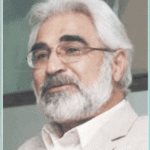
Founder and Former Director of the University Publishing Center (1980–2004)
Dr. Nasrollah Pourjavady, the son of Mashallah and a member of a family originally from Isfahan, was born in Tehran. After completing high school, he pursued his higher education in the United States, earning his Bachelor’s degree in Philosophy from the University of San Francisco.
Upon returning to Iran in 1967 (1346), he entered the Faculty of Literature and Humanities at the University of Tehran, where he received his Master’s degree in Philosophy in 1972 (1351) and later his Ph.D. in Philosophy in 1978 (1357).
In 1980 (1359), Dr. Pourjavady founded the University Publishing Center and served as its Director until 2004 (1383)
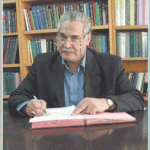
Dr. Farid Mor
Director of the University Publishing Center (July 2004 – July 2006)
Dr. Farid Mor was born in 1949 (1328) in Abadan, Iran. He received his Ph.D. in Economic Geology from the University of London.
In addition to his work as a translator, he has authored several significant academic works, including “Glossary of Geology” and the “Comprehensive Dictionary of Earth Sciences.”
Dr. Mor served as the Director of the University Publishing Center from July 2004 to July 2006 (Tir 1383 – Tir 1385).
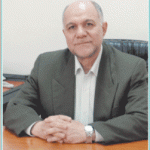
Dr. Mohammad Mahmoudi Hashemi
Director of the University Publishing Center (July 2006 – December 2008)
Dr. Mohammad Mahmoudi Hashemi was born in 1949 (1328) in the holy city of Mashhad, Iran. He earned his Ph.D. in Organic Chemistry from Sharif University of Technology.
He served as the Director of the University Publishing Center from July 2006 to December 2008 (Tir 1385 – Azar 1387).
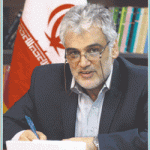
The Late Martyr Dr. Mohammad-Mehdi Tehranchi
Director of the University Publishing Center (December 2008 – June 2012)
The late Martyr Dr. Mohammad-Mehdi Tehranchi was born in 1965 (1344). He received his Master’s degree in Physics from Shahid Beheshti University in 1992 (1371) and earned his Ph.D. in Theoretical Physics from Moscow State University in 1997 (1376).
He served as the Director of the University Publishing Center from December 2008 to June 2012 (Azar 1387 – Khordad 1391).

Dr. Bahman Hajipour
Director of the University Publishing Center (June 2012 – December 2014)
Dr. Bahman Hajipour was born in 1965 (1344). He obtained his Ph.D. in Strategic Management (Business Policy) from Shahid Beheshti University in 2006 (1385).
He served as the Director of the University Publishing Center from June 2012 to December 2014 (Khordad 1391 – Azar 1393).

The Late Dr. Hossein Mohammadi Dustdar
Director of the University Publishing Center (March 2015 – November 2017)
The late Dr. Hossein Mohammadi-Dustdar was born in 1949 (1328). He earned his Ph.D. in Civil Engineering (Concrete Structures) from the University of Ottawa, Canada, in 1994 (1373).
He served as the Director of the University Publishing Center from March 2015 to November 2017 (Esfand 1393 – Aban 1396).

Dr. Hossein Ebrahimabadi
Director of the University Publishing Center (November 2017 – August 2022)
Dr. Hossein Ebrahimabadi was born in 1960 (1339). He obtained his Ph.D. in Educational Psychology from Allameh Tabataba’i University in 2008 (1387).
He served as the Director of the University Publishing Center from November 2017 to August 2022 (Aban 1396 – Mordad 1401).

Dr. Hassan Soodmand Afshar
Director of the University Publishing Center (August 2022 – July 2025)
Dr. Hassan Soodmand Afshar was born in 1973 (1352). He obtained his Ph.D. in Teaching English as a Foreign Language (TEFL) from the University of Isfahan in 2004 (1383).
He served as the Director of the University Publishing Center from August 2022 to July 2025 (1 Shahrivar 1401 – 21 Tir 1404).